Buyer guide
LPR Systems for HOAs & Gated Communities
Compare LPR systems for HOA and gated-community vehicle identification, gate access, resident and visitor workflows, installation, privacy, and cost.
There is no universal “best HOA LPR system.” A community seeking managed vehicle evidence may favor a different architecture from one replacing gate credentials. A community with suitable IP cameras and an experienced integrator may accept more technical ownership than a board that wants one vendor responsible for the field hardware and service.
This guide evaluates six documented approaches for HOAs, gated communities, private residential communities, multifamily entrances, community associations, property managers, security operators, and access-control integrators. It does not claim hands-on testing or infer an integration from a generic API label.
What an HOA actually needs from LPR
Resident recognition
A current list or credential record must connect each approved plate to the right entrance, schedule, household or user, and operational policy. Multi-vehicle households and replacement vehicles need a defined update process.
Visitor and contractor handling
A plate allowlist is not automatically a visitor-management system. Confirm who can add a plate, whether access expires, how invitations and approvals work, and what happens when the visitor arrives in a different or rental vehicle.
Gate action and fallback
The design must identify the controller, input or integration, safety devices, timing, failure behavior, manual override, and alternate credential. A recognized plate should not be assumed to open a gate without that documented path.
Search, alerts, and audit history
Boards should define which events are retained, which users can search or export them, whether plate and gate events can be correlated, and which user and configuration actions are auditable.
Role-based operations
Property management, guards, board members, installers, and residents do not need the same access. Verify site-level permissions, administrator controls, temporary access, multifactor authentication, and offboarding.
Governance
Ownership, retention, external sharing, law-enforcement access, exports, deletion, incident response, and renewal or termination rules need written board policy and contract language.
Quick comparison
Vendor documentation reviewed September 26, 2026. “Best fit” is an editorial assessment of documented architecture—not an overall ranking or recognition-performance test.
How LPR works at a gated entrance
A typical flow has separate capture, recognition, authorization, control, and logging stages. Those stages may run in one camera, several local devices, a cloud platform, or products from multiple vendors. Every handoff needs a named owner.
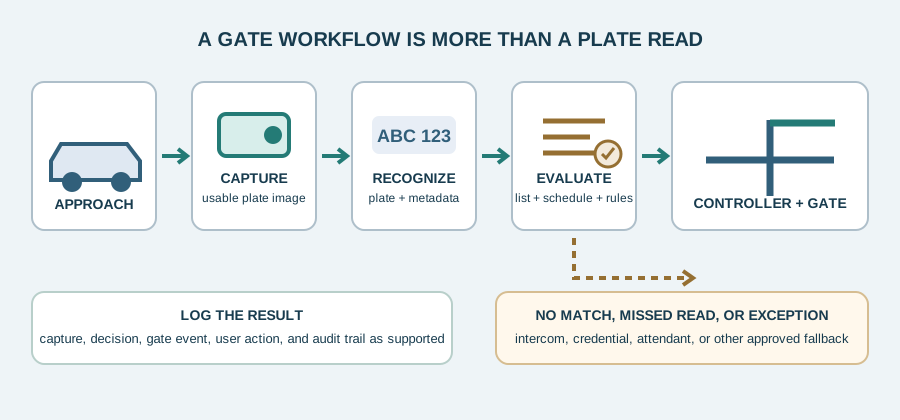
- Vehicle approaches: speed, lane position, tailgating, queuing, landscaping, and the existing gate equipment shape the design.
- Camera captures a usable image: the plate must be large, sharp, illuminated, and within the vendor’s documented angle and distance requirements.
- Software recognizes the plate: processing may occur on the camera, a local appliance/server, or vendor cloud.
- Rules evaluate the result: a list, user credential, permit, site, direction, and schedule may determine eligibility.
- The access-control path acts: a camera I/O, relay, controller, API, or custom integration may request an opening; safety logic remains part of the gate system.
- The system logs what occurred: plate events, access decisions, video, alerts, searches, exports, and administrative actions may be separate records with separate retention.
No match, a missed read, obscured plate, or unauthorized vehicle needs an approved fallback such as an intercom, attendant, clicker, mobile credential, keypad, RFID credential, or manual verification. Availability depends on the selected access-control system, not on LPR alone.
Best system type by HOA use case
Turnkey managed entrance monitoring
Flock is the clearest managed option in this shortlist for communities prioritizing vendor-supplied cameras, solar/LTE deployment, searchable vehicle evidence, alerts, installation, and lifecycle support. It is not the documented choice here for opening a gate; no native private-property gate-control path was found.
Existing-camera software
Compare Plate Recognizer and Rekor Scout Pro. Both can work with suitable buyer-controlled camera streams. Plate Recognizer documents a separate gate application; Rekor documents monitoring, alerts, API, webhooks, and integration outputs but not a ready gate controller.
Local or edge gate workflows
Axis has the most explicit packaged edge gate documentation in this group. Vaxtor is also relevant where an integrator wants embedded lists and direct I/O on supported partner cameras. Neither makes camera placement or gate safety plug-and-play.
Centralized video and access control
Verkada documents the tightest single-platform credential workflow. LPR Unlock connects a compatible Verkada LPR camera with a compatible Verkada access controller and applies user access levels and schedules. It requires the Verkada ecosystem.
Flexible integrator deployment
Plate Recognizer, Axis, and Vaxtor expose different integration boundaries. Plate Recognizer separates recognition, ParkPow, and a local gate application; Axis supports I/O, relay, controllers, and HTTP events; Vaxtor documents local lists, I/O, API, and third-party protocols.
Vehicle intelligence without gate replacement
Flock, Rekor, Verkada, Plate Recognizer, Axis, and Vaxtor can all support plate-event investigation in documented configurations. The better fit depends on camera ownership, retention, user controls, search features, connectivity, and support—not the LPR acronym.
These are conditional fit assessments, not universal winners. The private-property camera guide, software comparison, and ALPR versus LPR guide explain the underlying system boundaries.
System profiles
Complete managed monitoring system
Flock Safety
- Best for
- HOAs wanting managed entrance monitoring, searchable vehicle evidence, and alerts with minimal infrastructure ownership
- System type
- Flock-supplied camera, LTE, cloud software, installation, maintenance, and support
- Pricing status
- Quote required for private-property subscriptions, protection, and final site scope
Key strengths
- Documented HOA deployments and a single managed service boundary
- Solar/LTE architecture can avoid buyer network and power extensions where site conditions permit
Key constraints
- No current public private-property gate-opening or access-controller integration was found
- The Resident Safelist is a privacy feature, not a documented access credential
Deployment notes: Use Flock as a vehicle-monitoring and investigation platform unless a written proposal establishes a supported gate path. Verify placement, cellular/solar suitability, sharing settings, retention, installation exclusions, and contract terms.
Gate and workflow notes: Flock’s current HOA material describes entrance/exit LPR, searchable vehicle evidence, alerts, a Resident Safelist, and a managed subscription. It does not publicly document relay, Wiegand, OSDP, or a native resident/visitor gate credential workflow for this offer. Do not assume a hotlist or Safelist operates the gate.
Data and operations: Flock’s current contract explanation states that the customer owns Customer Data, sharing is off by default unless directed or authorized, and data is available to authorized users during the retention period in the order form. Boards should still document who may search, share, export, or authorize law-enforcement access.
Official sources: HOA LPR overview, privacy and Resident Safelist, data ownership and sharing, and pricing overview.
Integrated camera and access-control platform
Verkada LPR with LPR Unlock
- Best for
- Communities and multifamily operators willing to standardize LPR cameras and gate control in Verkada Command
- System type
- Compatible Verkada camera with on-camera recognition plus Verkada access controller and cloud management
- Pricing status
- Published camera and license catalog; complete installed gate configuration requires a quote
Key strengths
- Native plate credential, access-level, schedule, event-history, and API workflow
- Centralized search, alerts, roles, audit logs, and multi-site administration in Command
Key constraints
- Requires compatible Verkada cameras, access-control devices, and licensing
- No dedicated HOA resident self-service or visitor-invitation workflow was found in the reviewed LPR documentation
Deployment notes: For best results, the LPR camera and access device should share a LAN; Verkada warns offline functionality may be limited when they are separated across networks or VLANs.
Gate and workflow notes: LPR Unlock assigns a plate as a credential to an access user. It inherits access levels and schedules, generates an access event with the captured plate, and can expose events through Verkada access-control APIs. Plates can be configured individually or through CSV-oriented administration. The reviewed guide does not describe Wiegand or OSDP as the LPR-to-controller path.
Resident and visitor boundary: an administrator can provision a known vehicle to a user, including an approved guest if community policy permits. That is not evidence of a resident-facing guest portal, automated invitation, rental-car exchange, or temporary permit workflow; confirm those processes separately.
Official sources: LPR Unlock integration guide, LPR camera guide, Command audit logs, and pricing catalog.
Existing-camera software with integrator gate application
Plate Recognizer Stream, ParkPow, and Gate Opener
- Best for
- Technically supported communities wanting camera, compute, hosting, parking, and integration flexibility
- System type
- Stream recognition software, optional ParkPow platform, and local Raspberry Pi gate application
- Pricing status
- Published modular subscription prices; field hardware, compute, integration, and installation are separate
Key strengths
- Documented webhook-to-local-list-to-GPIO gate workflow
- Cloud and on-premises choices, vehicle tags, multi-camera/site administration, roles, API, and alerts
Key constraints
- Buyer or integrator owns camera suitability, compute, network, Raspberry Pi, wiring, security, commissioning, and support boundaries
- Vehicle tags are flexible records, not a complete HOA visitor-management product
Deployment notes: Stream can process compatible live feeds in the vendor cloud or buyer-managed environment. Gate Opener receives events locally, synchronizes a ParkPow list, and drives a configured gate input.
Gate and workflow notes: the documented Gate Opener runs on a Raspberry Pi, receives Stream webhooks, compares plates with a local whitelist synchronized from ParkPow, and operates GPIO connected to request-to-exit, relay, or other control-signal inputs. Its example supports separate cameras, vehicle tags, and I/O pins for multiple gates and shows Management, Tenant, and Visitor tags.
Important boundary: the integrator must determine whether the gate controller accepts the documented signal safely, how credentials expire, how users request changes, and how exceptions are handled. Wiegand and OSDP are not documented as the Gate Opener path.
Official sources: Gate Opener documentation, ParkPow overview, ParkPow users and roles, and pricing.
Local edge application and access-control ecosystem
AXIS License Plate Verifier
- Best for
- Integrator-led communities prioritizing local recognition, local lists, and documented barrier-control choices
- System type
- Application on compatible Axis cameras with optional I/O, relay, door controller, Secure Entry, or Camera Station components
- Pricing status
- Quote required for the camera, per-camera application license, controller/VMS, storage, installation, and support
Key strengths
- Documented internal I/O, network relay, controller, allowlist, schedule, user credential, and event-log workflows
- Local event storage and event buffering can reduce dependence on continuous cloud connectivity
Key constraints
- Requires compatible Axis hardware and integrator design across camera, network, storage, access control, and gate safety
- The application does not document an HOA-specific resident or visitor portal
Deployment notes: Recognition and list evaluation run on the camera. Lists can be managed locally or synchronized across supported cameras, and wider roles/audit/multi-site behavior depends on the selected Axis platform.
Gate and workflow notes: Axis documents opening a barrier from a camera’s internal I/O or an Axis network relay and also documents compatible Axis door-controller and Secure Entry paths. License plates can be assigned as user credentials with groups and schedules. HTTP POST, TCP, and the License Plate Verifier API support other integrations.
Data and operations: the application stores plate events in camera memory or supported storage with configurable selection and retention. Wider user roles, audit logs, mobile access, exports, and centralized administration depend on the camera, AXIS OS, and any Camera Station or Secure Entry deployment selected.
Official sources: License Plate Verifier manual, product overview, and License Plate Verifier API.
Embedded integrator software
Vaxtor VaxALPR On Camera
- Best for
- Access-control integrators building a local solution on supported technology-partner cameras
- System type
- On-camera recognition with embedded lists, direct I/O, API, and third-party event protocols
- Pricing status
- Quote required; public standard license, installation, and support totals were not found
Key strengths
- Local white/blacklist checks and edge actions can continue without a cloud round trip
- HTTP/HTTPS, ONVIF/VAPIX and other documented outputs support integrator-controlled architectures
Key constraints
- Compatibility, list scale, storage, controller wiring, user interface, roles, and support vary with camera and surrounding platform
- No packaged HOA resident, visitor, rental-car, or temporary-vehicle workflow was found
Deployment notes: Select a supported partner camera with sufficient resources, then design the I/O or event path, list administration, VMS/back-office connection, retention, permissions, and support model.
Gate and workflow notes: Vaxtor documents embedded white/blacklists, CSV/API administration, direct camera I/O actions, and use cases that include opening barriers. Its broader integration surface can feed third-party platforms. The exact relay/controller, Wiegand or OSDP path, resident UI, visitor workflow, and failure behavior are not standardized on the reviewed product page.
Official sources: VaxALPR On Camera and the linked technology-partner configuration manuals.
Existing-camera monitoring and integration platform
Rekor Scout Pro
- Best for
- Communities, property managers, or security teams reusing suitable cameras for searchable vehicle monitoring
- System type
- Local recognition agent with cloud or self-hosted Scout dashboard and configurable integration destinations
- Pricing status
- Published at $72/month per connected camera for Pro; compute, storage, field hardware, integration, and installation are separate
Key strengths
- Works with compatible HTTP/RTSP streams and documents search, sites, lists, alerts, users, permissions, REST API, webhooks, and local output options
- Cloud and self-hosted data destinations are available for Pro
Key constraints
- No native gate relay, Wiegand, OSDP, controller, or packaged resident/visitor access workflow was found
- A custom API or webhook integration is a software project, not verified gate compatibility
Deployment notes: Use Scout as the recognition and monitoring layer unless an integrator separately specifies, tests, supports, and documents the access-control path and fallback behavior.
Gate and workflow notes: Scout can send plate and alert events by webhook, expose search through its REST API, or use a local queue/custom HTTP destination. Those interfaces can inform another application, but the reviewed documentation does not establish a supported gate-opening product or controller certification.
Data and operations: Pro documents retention up to 60 days, cloud or self-hosted data, sites, users, permission groups, lists, alerts, API, and webhooks. A public product-specific customer-data ownership statement, HOA visitor workflow, and comprehensive audit-log specification were not established.
Official sources: Scout overview, plans and retention, webhooks, and user management.
Can LPR replace clickers, decals, or RFID?
Sometimes LPR can become a primary vehicle credential, but it should not be assumed to replace every credential or exception path. Plate recognition removes the need to reach for a clicker or badge when a readable, authorized plate approaches under supported conditions. It also creates a vehicle event that a conventional transmitter may not provide.
Plate-only access still has practical exceptions:
- Motorcycles may approach differently or have rear-only, small, angled, or obscured plates.
- Temporary paper tags, damaged or dirty plates, glare, weather, trailers, and plate frames can affect capture.
- Rental cars, dealer loaners, replacement vehicles, and new plates require fast credential updates.
- Guests, deliveries, contractors, emergency services, and service vehicles may not have a plate registered in advance.
- A recognition or list mismatch must not strand a resident or create an unsafe queue.
- Power, network, server, cloud, controller, or camera outages require defined behavior.
A resilient design commonly retains one or more approved fallbacks—such as intercom verification, an attendant, keypad, clicker, RFID/mobile credential, or manual controller action—based on the community’s gate and safety design. The vendor and integrator should test failure modes before LPR becomes the primary credential.
Resident, visitor, and temporary-vehicle workflows
Residents
Decide who approves plates, how many vehicles a household may register, whether plates inherit schedules or entrance limits, how duplicates are handled, and how a move-out immediately revokes access.
Guests
Define who can invite a guest, whether the resident or manager enters the plate, when authorization starts and expires, whether repeat guests are allowed, and what happens when the guest arrives in a different vehicle.
Contractors and deliveries
Use time, entrance, direction, or service-window restrictions where the selected platform supports them. Keep a staffed or intercom path for unplanned deliveries and vendors whose vehicle changes.
Rental and replacement vehicles
Provide a quick, auditable update process with automatic expiration. Avoid leaving the old vehicle authorized indefinitely, and confirm which role may change a resident’s credential.
Temporary and paper tags
Ask vendors to validate the actual plate types and placement likely at the property. Do not infer temporary-tag performance from a general recognition claim.
Multiple vehicles and entrances
Confirm credential limits, list synchronization, entrance-specific rules, direction handling, concurrent use, anti-passback expectations, and how additions propagate during an outage.
Vendor-specific evidence is uneven. Verkada documents plate credentials tied to users, access levels, and schedules. Axis documents plate credentials, groups, schedules, and lists. Plate Recognizer documents vehicle tags—including a Visitor example—in ParkPow’s Gate Opener workflow. None of those facts alone proves a complete resident self-service or guest-invitation system.
Installation considerations for gated communities
- Approach speed and stopping behavior
- A gate queue may slow vehicles, but acceleration, rolling entry, tailgating, and lane changes still affect capture. Design to the documented speed at the actual recognition point.
- Mounting angle, distance, and plate size
- Validate the vendor’s horizontal/vertical angle, focal length, pixel size, and region-of-interest requirements. A convenient gatehouse wall is not automatically a suitable camera position.
- Lane geometry and direction
- Entry and exit lanes, visitor lanes, medians, curves, stacking distance, and multi-lane occlusion can require separate views, licenses, or context cameras.
- Lighting and infrared
- Headlights, reflective plates, shade, low sun, gatehouse lighting, and darkness should be tested. General scene lighting and plate-optimized illumination serve different purposes.
- Power and connectivity
- PoE/Ethernet can support local devices and low-latency integrations; solar/cellular may avoid trenching for monitoring cameras. A gate controller still needs its own approved power, network, wiring, and safety design.
- Controller proximity and wiring
- Document the path from recognition output to the controller or RTE/relay input, including enclosure, surge protection, isolation, cable distance, network security, and who supports each endpoint.
- Site work
- New poles, foundations, conduit, trenching, electrical work, traffic control, permits, utility locating, restoration, and gate modifications may sit outside the product quote.
- Survey and commissioning
- Test day/night capture, every lane and direction, authorized/unauthorized plates, ambiguous characters, temporary tags, alerts, controller timing, safety loops, network loss, power loss, manual override, and event logging.
The License Plate Reader Cost & Installation Guide explains how hardware, software, site preparation, connectivity, and recurring ownership costs should be separated in proposals.
Privacy and governance questions for HOA boards
Plate records can reveal vehicle presence and movement. Before deployment, the association should obtain appropriate legal and insurance guidance for its jurisdiction and governing documents. This guide is not legal advice.
- Ownership: who contractually owns plate text, images, video, lists, user records, gate events, and derived metadata?
- Authorized access: which board, manager, security, installer, and vendor roles can view, search, export, configure, or share data?
- Retention: what is retained, where, for how long, and can the board shorten it? Do exports, archives, audit logs, and backups follow different periods?
- External sharing: is sharing off by default, who may approve it, can access be limited and revoked, and how is every action logged?
- Law-enforcement access: is access direct, case-specific, customer-approved, network-wide, or unavailable? What changes if the association voluntarily shares data?
- Auditability: are searches, exports, sharing changes, list edits, user changes, gate overrides, and support access recorded and reviewable?
- Data portability and termination: what can be exported, in what format, before cancellation or expiration, and when is remaining data deleted?
- Policy and notice: who may use the system, for which purposes, under what approval and incident process, and what resident/visitor notice is required?
Do not assume one vendor’s governance terms apply to another. Even within one platform, the order form, product tier, customer configuration, local law, and whether the HOA enables external sharing can change the answer.
Questions to ask vendors before signing
- Is gate integration a supported native feature, a documented vendor application, an integrator customization, or merely technically possible?
- Which exact camera, lens, illuminator, mount, pole, power supply, network device, server, relay, controller, and safety components are required?
- Does the proposed path use internal I/O, a relay/RTE input, Wiegand, OSDP, API, webhook, vendor controller, or another method—and is that method publicly supported?
- How are resident plates created, approved, limited by entrance or schedule, updated, expired, and removed?
- How are guests, contractors, deliveries, rental cars, loaners, replacement vehicles, temporary tags, and multiple-vehicle households handled?
- What happens after a missed read, partial read, false match, unreadable plate, duplicate plate, or unauthorized attempt?
- Which manual override and alternate credentials remain available, and who can use them?
- What happens during camera, power, LAN, internet, cloud, server, integration, or controller failure?
- Which amounts are one-time, recurring, usage-based, renewal-based, or outside the quote?
- Does installation include survey, permits, poles, electrician, conduit, trenching, network, controller wiring, safety testing, aiming, night validation, commissioning, and training?
- What changes at renewal, expansion, relocation, cancellation, or end of term?
- Who owns and can export each data type, and in which formats?
- What are the default retention, sharing, law-enforcement access, role, audit, support-access, and deletion settings?
- Which organization supports each failure: LPR vendor, camera vendor, network provider, gate company, access-control vendor, property manager, or integrator?
Use the Flock alternatives guide when comparing a managed system with edge and software-first approaches. The Software & Systems hub and complete buyer-guide library contain the rest of the launch research.
Methodology, sources, and important unknowns
This guide was last verified on September 26, 2026. Plate Reader Guide reviewed current vendor product pages, configuration manuals, integration guides, help documentation, pricing pages, and data-policy materials. It did not install, operate, or benchmark any system and did not treat a generic API, webhook, access-control use case, or partner relationship as proof of a specific gate integration.
Major primary sources: Flock HOA LPR, privacy controls, and data ownership; Verkada LPR Unlock; Plate Recognizer Gate Opener and ParkPow; AXIS License Plate Verifier and its API; Vaxtor VaxALPR On Camera; and Rekor Scout, webhooks, and plans and retention.
Important unknowns: no reviewed source established a shared cross-vendor gate standard, universal Wiegand or OSDP support, a common HOA visitor workflow, uniform mobile access, uniform outage behavior, or a comparable installed price. Data ownership, sharing, audit scope, exports, retention, support, and contract terms remain vendor-, tier-, configuration-, and proposal-specific.
Commercial disclosure: No vendor or source link on this page is currently an affiliate link. Normal outbound analytics may record a source click. Read the editorial policy and affiliate disclosure.