Buyer guide
ALPR vs. LPR: What Businesses Actually Need
Learn how ALPR and LPR terminology overlaps—and what businesses should compare across cameras, software, alerts, access control, data, installation, and cost.
An HOA, gated community, multifamily operator, parking business, self-storage facility, dealership, commercial property, private security team, or integrator should search both terms. Then compare the actual system boundary. A page labeled ALPR may describe only a recognition engine, while a product labeled LPR may automatically read plates on the camera, index them, match a list, and trigger an alert.
This guide interprets current vendor documentation; it is not based on hands-on testing and does not impose a universal definition that the market itself does not follow.
ALPR vs. LPR at a glance
Terminology reviewed September 26, 2026. Meanings vary by vendor, region, product family, and document.
Are ALPR and LPR the same thing? In practical buying conversations, often yes. ALPR makes automation explicit in the acronym; LPR often leaves it implicit. Neither label, by itself, tells you whether recognition runs on the camera, a local server, a vendor cloud, or some combination—or whether search, alerts, gate actions, and retention are included.
Why vendors use different terms
Legacy and regional language
Product names and documentation accumulate over time. North American materials frequently use LPR or ALPR, while ANPR—“number plate” rather than “license plate”—appears more often in international product language. That regional tendency is useful for searching, not a functional specification.
Camera versus software emphasis
A camera manufacturer may emphasize an LPR camera mode or on-device application. A software company may emphasize an ALPR engine that accepts images or video streams. A managed provider may use either term for the camera, analytics, platform, and service together.
Product marketing
Vendor-preferred acronyms become part of product names: AXIS License Plate Verifier, Plate Recognizer ALPR, Rekor Scout, Verkada LPR, and VaxALPR. The label helps identify the vendor’s documentation, but it does not create a cross-vendor capability standard.
Different automation boundaries
One product may automate only detection and OCR. Another may also index results, match a watchlist, send an alert, or pass an event to a gate system. Buyers must identify which steps occur automatically, which require configuration, and which require another product.
What “automatic” can mean
In an operational system, automation is a chain of separate functions. A vendor may support some or all of them:
- Plate detection: identifying that a plate is present in an image or video frame.
- Recognition: converting plate pixels into characters and associated metadata.
- Indexing and search: saving a result with time, camera, site, image, video, or vehicle information so an authorized user can find it later.
- List matching: comparing a read with a configured hotlist, blocklist, allowlist, permit list, or other record set.
- Alerts: notifying selected users or another system when configured conditions match.
- Business action: presenting an investigation result, exporting an event, starting a parking workflow, or asking an access-control system to evaluate entry.
“Automatic” does not mean every resulting action should be unsupervised. Gate and barrier projects still need documented controller logic, schedules, safety devices, failure behavior, authorization rules, and commissioning. Investigative alerts still need policy, permissions, review, and auditability.
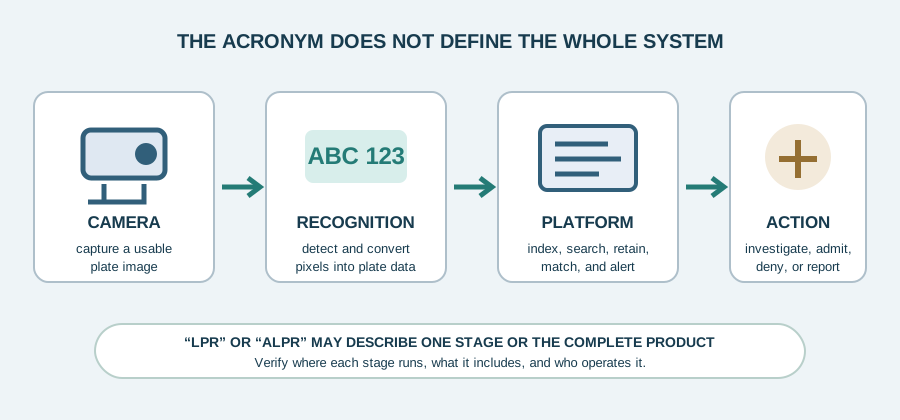
Camera, software, platform, and complete system
Camera hardware
The camera must create a plate image suitable for the documented distance, angle, vehicle speed, lane width, lighting, weather, and plate format. A general overview camera may provide useful context without producing reliable plate characters.
Recognition engine
The engine performs detection and character recognition. It can run on a supported camera, a nearby edge computer, a local server, or vendor cloud infrastructure. The acronym does not reveal that location.
Management and search platform
A platform can add searchable history, sites, users, roles, lists, alerts, exports, API access, audit records, retention settings, and integrations. Recognition software alone may not provide these operational tools.
Complete managed system
A managed offer can bundle the camera, connectivity, cloud platform, installation, maintenance, and support. That can simplify ownership, but it is a different buying boundary from licensing software for existing cameras.
Use the private-property camera guide to compare capture and deployment models, the software guide to compare platforms, and the cost and installation guide to compare ownership boundaries.
What businesses should compare instead
Capture and site fit
- Supported cameras, lenses, and firmware—not merely “works with IP cameras”
- Documented night, glare, weather, plate-region, vehicle-speed, and lane limits
- Mounting distance, height, angle, direction of travel, and context-camera needs
- Power design: PoE, AC, battery, or solar
- Connectivity: Ethernet, fiber, Wi-Fi, LTE/5G, and offline behavior
Processing and workflow
- Recognition location: camera, edge appliance, local server, cloud, or hybrid
- Search, watchlists/allowlists, approximate matching, alerts, exports, and reporting
- Latency from capture to event or alert under the proposed architecture
- API, webhooks, event formats, rate limits, and supported integrations
- Gate/access-control path, controller compatibility, schedules, and failure behavior
Data and governance
- Retention for plate text, images, video, exports, archives, and audit logs
- Customer data rights, deletion, portability, and end-of-contract access
- Roles, site permissions, multifactor authentication, and auditability
- External and law-enforcement sharing controls, defaults, approvals, and revocation
- Local legal, notice, policy, and record-handling requirements
Commercial and operational fit
- Hardware, software, installation, site work, connectivity, storage, and support
- Recurring fees, renewal terms, price changes, minimum commitments, and expansion
- Warranty, protection, replacement, relocation, maintenance, and response times
- Who monitors camera health, tunes recognition, handles false matches, and trains users
- Which vendor or integrator owns each support boundary
How major vendors describe their products
This table records current vendor wording and architecture. It does not treat the terminology as a capability ranking.
Primary vendor pages and documentation reviewed September 26, 2026. Product boundaries are summarized for commercial comparison; terminology alone does not determine performance or fit.
What the examples demonstrate
- LPR can still be automatic: Verkada calls its feature LPR even though supported cameras automatically recognize and index plates; Axis similarly uses LPR for an edge application with lists, events, and access-control functions.
- ALPR does not identify the deployment location: Plate Recognizer uses ALPR for cloud and on-premises software, Rekor uses it for a local agent plus cloud or self-hosted destinations, and Vaxtor uses it for software embedded on supported cameras.
- The same vendor may use several labels: Flock and Vaxtor use multiple terms across current product and explanatory material. Rekor’s Scout overview uses both ALPR and LPR language.
- The acronym does not identify the buying model: the examples range from software-only and edge applications to cloud-managed platforms and complete managed systems.
Which term should you search for when buying?
Search for LPR, ALPR, and—when international products or documentation are relevant—ANPR. Combine the acronym with the actual workflow: “gate access,” “parking permits,” “existing IP cameras,” “on-camera,” “on-premises,” “webhooks,” “multi-site,” or “managed system.” This is more likely to uncover the right architecture than choosing one acronym and excluding the others.
Shortlist products by their documented functions, then require a site-specific design and written responsibility matrix. The Flock alternatives guide is useful when comparing a managed system with software-first and edge approaches.
When terminology does matter
- Procurement and contracts
- Use the same defined term throughout a specification, but attach functional requirements. “ALPR system” should not substitute for camera, recognition, retention, alerting, integration, installation, support, and governance requirements.
- Integration documentation
- Vendor product names, API paths, event types, and license names can depend on the vendor’s chosen acronym. Search its exact language when validating a connector or support boundary.
- International research
- ANPR searches can surface international products and documentation that LPR-only searches miss. Confirm supported countries and plate formats rather than inferring coverage from the term.
- Law and policy
- A statute, contract, association policy, or customer rule may define “automatic,” “automated,” “reader,” or “recognition” in a specific way. Use the controlling definition for that context; marketing usage is not legal guidance.
Related buyer guides
Methodology, sources, and terminology limits
This guide was last verified on September 26, 2026. Plate Reader Guide reviewed current first-party product pages, help articles, and documentation from the vendors below. It compared the words vendors use with the architectures and workflows they document. No product was hands-on tested, and no terminology was treated as a performance claim.
Major primary sources: Flock’s ALPR/LPR terminology and HOA LPR system description; Verkada’s LPR/ALPR/ANPR explainer and Verkada LPR overview; AXIS License Plate Verifier; Plate Recognizer ALPR overview; Rekor Scout overview; and Vaxtor VaxALPR On Camera.
Important inconsistency: there is no universal vendor rule that ALPR is more automated, more accurate, more cloud-based, or more complete than LPR. Even the final word in ALPR is expanded differently in some material. ANPR generally changes “license” to “number,” but does not define an architecture or guarantee geographic coverage.
Claims intentionally avoided: this guide does not rank acronym popularity with unsupported market-share data; declare one term technically superior; infer accuracy, speed, lane count, plate coverage, automation, or integration from naming; or treat a marketing label as a legal definition.
Commercial disclosure: No vendor or source link on this page is currently an affiliate link. Normal outbound analytics may record a source click. Read the editorial policy and affiliate disclosure.