Buyer guide
License Plate Reader Cost & Installation Guide
Understand commercial LPR system costs across cameras, software, installation, site work, power, connectivity, subscriptions, and ongoing ownership.
This guide is for HOAs, gated communities, multifamily properties, parking operators, self-storage facilities, dealerships, commercial properties, private security teams, integrators, and multi-site businesses. It explains cost structure using current vendor documentation; it does not present a national average, labor-rate assumption, or hands-on installation test.
LPR cost at a glance
Cost information reviewed September 26, 2026. Every dollar figure is identified as published; undocumented totals remain quote-only.
What makes up the total cost
1. Camera and field hardware
The field bill can include a purpose-built LPR camera or a supported security camera, lens, infrared illumination, mount, weather enclosure, pole, solar panel, battery, PoE injector or switch, modem, surge protection, edge computer, recorder, storage, and gate I/O. A camera price alone does not establish that these pieces are included.
2. Software and subscription
Software may be licensed per camera, gate, site, server, or organization. Search, retention, vehicle attributes, alerts, parking workflows, API access, cloud management, and support may sit in separate tiers. Perpetual licensing can still carry maintenance, hosting, upgrade, or support costs.
3. Installation and commissioning
Installation includes more than fastening a camera to a pole. A usable scope should cover survey, lane design, safe access, mounting, power/network termination, aiming, focus and exposure, day/night validation, software activation, list or alert setup, integration testing, documentation, and operator handoff.
4. Site preparation
New poles, foundations, trenching, conduit, concrete cutting, private utility locating, engineered drawings, traffic control, permits, attachment rights, electrical upgrades, restoration, and special equipment can sit outside the camera vendor’s default scope. These costs are site-specific and require written quotes.
5. Connectivity
Hardwired designs may require PoE switching, copper-distance planning, fiber, network configuration, and secure internet egress. Cellular designs add modem, antenna, coverage, data-plan, and carrier-management questions. Wi-Fi can avoid a cable only when coverage, capacity, security, and interference are suitable at the actual mount.
6. Ongoing ownership
Budget renewals, storage, cellular service, electricity, support, administrator time, camera cleaning, vegetation control, firmware and software work, replacements, protection plans, relocation, re-aiming after site changes, and future expansion. The contract should state who owns each responsibility.
Turnkey versus existing-camera cost structure
No architecture is always cheaper. The table shows where costs and operating responsibility usually sit.
A turnkey platform can reduce the number of vendors and internal skills needed, but its recurring fee may bundle hardware and services that another proposal itemizes. Existing-camera software can preserve suitable infrastructure, but only if the installed views, shutter behavior, illumination, resolution, and network streams are adequate for plates. Read the LPR software comparison and private-property camera guide before treating camera reuse as guaranteed savings.
Installation cost drivers
- Existing pole versus a new pole
- A structurally suitable pole with the right view, attachment permission, safe access, power, and network can remove work—but “a pole exists” does not prove it is usable. A new pole can add utility locating, foundation or breakaway requirements, engineering, permitting, traffic control, and restoration.
- Power already available versus electrical work
- PoE can carry power and data over one cable within the network design. AC-powered or long-distance sites may require a licensed electrician, new circuits, breakers, surge protection, conduit, and utility coordination. Flock’s current implementation guide explicitly assigns customer-provided AC work to a licensed electrician and says the amount is unavailable because each location differs.
- Ethernet, fiber, Wi-Fi, or cellular
- Ethernet and fiber shift cost toward cabling, switching, and network labor. Cellular can reduce dependence on the property network and may help avoid long data runs, but adds signal validation, modem/antenna, data service, and vendor-lock-in considerations. Solar can reduce the need to extend power, but depends on shading, weather, orientation, battery design, and per-device placement constraints.
- Trenching, conduit, and surface restoration
- Distance and surface type matter because a route may cross soil, landscaping, asphalt, concrete, irrigation, or private utilities. The guide does not assign a dollar range: vendors and electrical/civil contractors must quote the actual route and restoration standard.
- Lane count, geometry, and context coverage
- One camera may cover one or several lanes only when the vendor supports it and the scene meets distance, angle, speed, occlusion, and plate-size requirements. A dedicated LPR view may also need a separate context camera. More entrances, directions, lanes, or context views affect cameras, mounts, licenses, network ports, storage, and installation visits.
- Gate and access-control integration
- A recognition event is not a complete gate system. Confirm controller, relay or request-to-exit path, safety loops, credential rules, schedules, visitor/resident workflow, failure behavior, commissioning, and who supports the integration. Existing gates can still require controller or wiring changes.
- Multi-site rollout
- Multi-site buyers should separate repeatable design work from local conditions. Each site can have different utilities, carrier signal, pole access, permits, network ownership, installer travel, storage, and gate equipment even when the software license is uniform.
Published vendor examples
The figures below are not a universal price list or complete installed-system quotes. Each amount is a current vendor-published line item. Procurement-derived figures and editorial estimates are not used.
USD figures and pricing status verified September 26, 2026. MSRP is not an installed price, and a service fee is not a complete subscription price.
What the software prices omit
Plate Recognizer and Rekor publish per-camera software subscriptions, but buyers must still price suitable cameras, compute, storage, networking, installation, monitoring, and integration. Plate Recognizer also publishes a separate dashboard, gate module, and remote professional-services session. Rekor’s documentation sizes the local agent from camera resolution, vehicle speed, stream count, traffic volume, and CPU load—so the server is a design input, not a free assumption.
What the camera MSRP omits
Verkada documents that compatible bullet and remote cameras can enable LPR without an additional LPR-specific license, but the camera still requires a Verkada camera license. Its MSRP does not establish reseller discount, tax, mount, PoE/network work, installation, optional context camera, access-control hardware, or site preparation.
What the managed fee schedule does—and does not—show
Flock’s published service schedule is useful for understanding defined installation, relocation, technician-visit, and damage-replacement charges. It does not publish the private-property annual subscription or protection-plan price. Use the Flock Camera Cost guide for camera-focused analysis and the Flock Safety Pricing guide for the subscription and contract boundary.
Recurring costs buyers forget
- Software and platform renewals: confirm the renewal unit, term, included features, price-change mechanism, and consequences of non-renewal.
- Connectivity: identify whether LTE/5G is bundled, separately billed, buyer-provided, pooled, capped, or subject to coverage changes.
- Retention and cloud storage: distinguish plate metadata, cropped images, full video, exports, archives, backups, and audit logs.
- Local compute and storage: include server replacement, operating-system administration, monitoring, backup, electricity, and capacity growth.
- Support and maintenance: confirm software updates, firmware, remote assistance, on-site labor, response times, travel, and excluded integrations.
- Protection and replacements: ask which damage, theft, vandalism, battery, solar, pole, cable, and power items are covered and whether a deductible or event limit applies.
- Relocation and re-commissioning: landscaping, construction, new signs, gate changes, lane restriping, or poor customer-selected placement can require a move or re-aim.
- Expansion: later cameras can add licenses, compute, switch ports, storage, carrier plans, mounts, poles, site surveys, and new contract minimums.
Questions to ask before accepting a quote
- Which amounts are one-time, recurring, usage-based, contingent, or payable at renewal?
- Does the buyer own the hardware, lease it, or receive it only while the service is active?
- Which exact camera, lens, illuminator, mount, pole, power kit, modem, storage, and edge-compute parts are included?
- Does “installation included” cover survey, permits, utility locating, pole work, electrician, conduit, trenching, concrete, restoration, network cabling, traffic control, lifts, aiming, night testing, and commissioning?
- Is cellular service included for the full term, and what carrier, coverage, data, antenna, and outage assumptions apply?
- What Ethernet, PoE, fiber, Wi-Fi, firewall, internet, bandwidth, and switch capacity must the buyer provide?
- Are gate relays, access controllers, safety devices, credentials, visitor/resident workflows, and integration labor included?
- What plate, image, video, archive, backup, and audit-log retention is included, and what does more retention cost?
- Which warranty, maintenance, protection-plan, replacement, vandalism, technician-visit, travel, and relocation terms apply?
- What changes at renewal: price, license quantity, minimum commitment, hardware rights, support, storage, or cancellation deadline?
- What will another camera, lane, gate, site, user group, API integration, or storage tier cost later?
- Which exclusions require third-party quotes, and who coordinates and warrants that work?
How to compare LPR quotes fairly
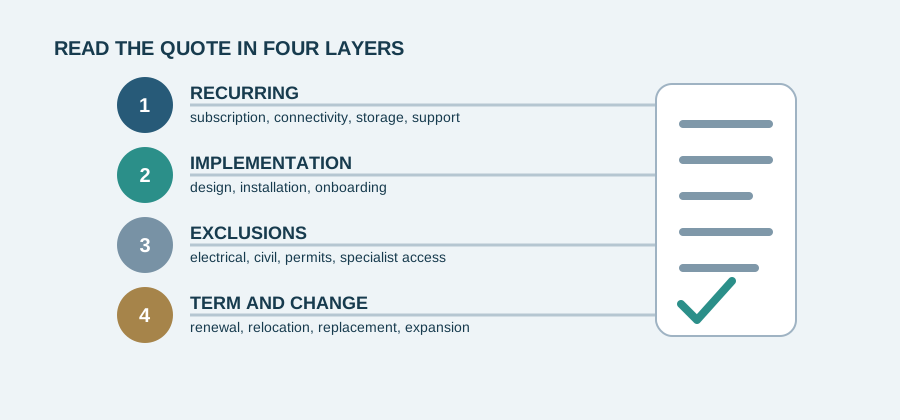
Normalize every proposal to the same sites, entrances, directions of travel, lane coverage, operating hours, plate-search workflow, retention, user roles, alerts, gate functions, integrations, support level, and contract term. Then separate six columns: hardware, software, installation, site work, connectivity, and ongoing ownership.
For each line item, mark who supplies it, who owns it, who installs it, who supports it, whether it recurs, and what assumption could trigger a change order. Compare the cost over a common term and show the end-of-term state: hardware ownership, data export, license expiration, removal obligations, and the price or process for renewal.
The Software & Systems hub and complete buyer-guide library provide the related architecture and vendor research.
Methodology, sources, and important unknowns
This guide was last verified on September 26, 2026. Plate Reader Guide reviewed current vendor pricing pages, product documentation, installation guides, implementation scopes, licensing materials, and fee schedules. It did not perform an installation, request a private quote, or use reseller pricing, national averages, marketplace listings, or unsourced labor assumptions.
Major primary sources: Plate Recognizer pricing and Stream system requirements; Rekor Scout pricing and licensing and Scout system requirements; Verkada September 2026 pricing and Verkada LPR guide; Flock implementation guide, Flock fee schedule, and Flock pricing overview; Axis License Plate Verifier; and Vaxtor VaxALPR On Camera.
Pricing classifications: Every dollar figure is labeled Published. Flock’s private-property subscription, Axis and Vaxtor project totals, and site-specific electrical/civil/network costs are labeled Quote-only. No procurement-derived or calculated deployment total is used.
Important unknowns: no reviewed source established a universal installed total, national labor rate, trenching or electrical range, standard reseller discount, consistent multi-site discount, or common contract term. Hardware, installation, retention, support, cellular, protection, gate-integration, expansion, and renewal scope varies by vendor and proposal.
Commercial disclosure: No vendor or source link on this page is currently an affiliate link. Normal outbound analytics may record a source click. Read the editorial policy and affiliate disclosure.